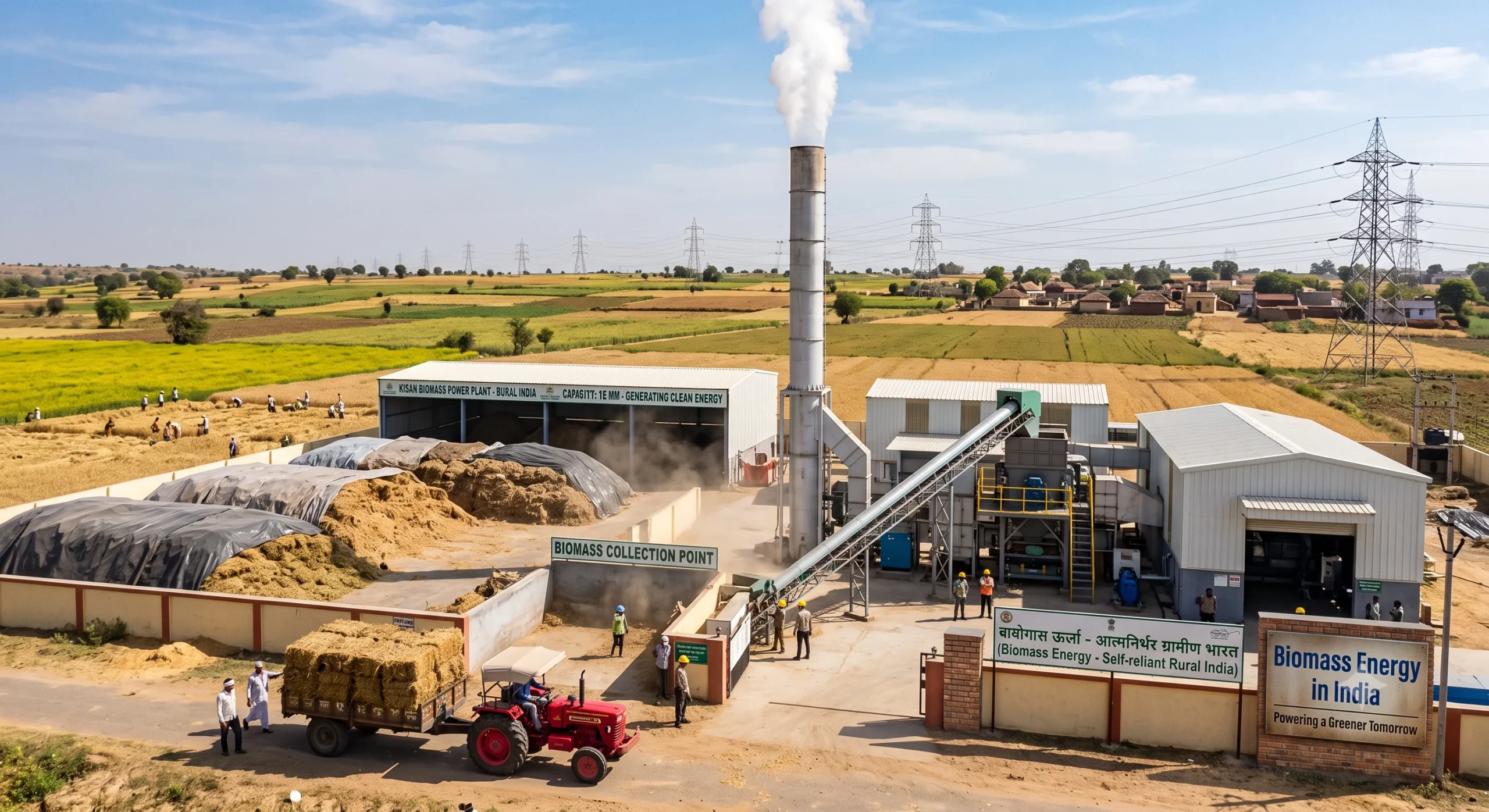
India has a large and diverse agricultural sector that produces millions of tonnes of crop residues every year. Rice husk, bagasse, straw, shells, stalks and other agricultural by-products are often considered waste. However, these materials can also become valuable sources of renewable energy when they are collected, processed and utilised through appropriate technologies.
Biomass energy offers an opportunity to convert locally available organic resources into useful heat, steam, electricity and other forms of energy while supporting more sustainable resource utilisation.
For industries located close to agricultural production centres, biomass can provide an important alternative or supplementary energy source.
What Is Biomass Energy?
Biomass energy is energy generated from organic materials derived from plants, agricultural residues, forestry resources and certain organic wastes.
Common biomass resources include:
- Rice husk
- Sugarcane bagasse
- Wood and forestry residues
- Coconut shells
- Groundnut shells
- Sawdust
- Agricultural straw
- Corn residues
- Other agro-industrial by-products
Depending on the characteristics of the biomass and the energy requirement, different technologies can be used to convert these resources into useful energy.
Why Biomass Is Important for India
Agriculture plays a major role in India’s economy, and agricultural activities generate substantial quantities of residues.
Instead of treating these materials only as waste, biomass-energy systems can create a productive use for suitable residues.
The benefits can include:
Waste Utilisation: Agricultural residues can be converted into useful energy rather than being discarded.
Renewable Energy Generation: Biomass can provide a renewable source of thermal or electrical energy when sustainably sourced.
Local Resource Utilisation: Industries can potentially use biomass resources available within their surrounding region.
Reduced Dependence on Fossil Fuels: Suitable biomass systems can reduce the requirement for conventional fossil fuels in certain industrial applications.
Rural Economic Opportunities: Biomass supply chains can create opportunities for collection, processing, transportation and storage.
Rice Husk: An Important Biomass Resource
Rice husk is one of the notable agricultural residues available in India. Rice-processing facilities generate significant quantities of husk during milling.
Rather than treating rice husk simply as a disposal problem, it can be considered as a potential energy resource.
With appropriate technology, rice husk can be used for thermal applications or power generation.
This is particularly relevant for rice mills and other agro-processing industries where the biomass resource is generated as part of the production process.
Biomass Gasification
Gasification is one technology that can convert solid biomass into a combustible gas known as producer gas or syngas, depending on the technology and operating conditions.
In a simplified gasification process:
Biomass + Controlled Heat + Limited Oxygen → Combustible Gas
The resulting gas can potentially be used for thermal applications or, with appropriate systems, electricity generation.
Gasification can be particularly interesting for industries that have a consistent supply of suitable biomass and require thermal energy or distributed power.
However, successful operation depends on factors such as biomass quality, moisture content, particle size, gasifier design, gas cleaning and system operation.
Biomass-Based Cogeneration
Another important application is cogeneration, also known as combined heat and power.
A cogeneration system produces useful thermal energy and electricity from the same energy source.
For example:
Biomass → Boiler → Steam → Turbine → Electricity + Process Steam
This approach can be attractive for industries that require both electricity and large quantities of process steam.
Potential applications include:
- Rice mills
- Sugar industries
- Food-processing facilities
- Textile industries
- Paper and pulp industries
- Chemical industries
- Other process industries
The feasibility of a cogeneration project depends heavily on the industry’s electricity and thermal-energy demand, biomass availability and operating profile.
Biomass and Circular Economy
Biomass energy can also support the principles of a circular economy.
In a conventional linear model, agricultural production generates residues that may require disposal. A circular approach looks for ways to return these materials into productive use.
For example:
Agricultural Production → Biomass Residue → Energy Generation → Industrial Production
This approach can help industries make better use of locally available resources while reducing waste.
What Makes a Biomass Project Successful?
Having access to biomass does not automatically make a project technically or financially viable.
Several factors need to be evaluated before selecting a biomass-energy system.
1. Biomass Availability
The quantity of biomass available throughout the year needs to be assessed. Seasonal availability can have a major impact on project planning.
2. Biomass Quality
Different biomass materials have different moisture levels, calorific values, ash content and handling characteristics.
3. Collection and Transportation
The cost and logistics of collecting biomass from different locations can significantly affect project economics.
4. Storage
Biomass often needs to be stored safely and efficiently to maintain a reliable fuel supply.
5. Energy Demand
The proposed system should match the industry’s actual electricity and thermal-energy requirements.
6. Technology Selection
Gasification, combustion, boilers, cogeneration and other technologies have different applications. Technology should be selected based on the specific characteristics of the project.
Biomass Energy and Carbon Reduction
Biomass is often discussed as a lower-carbon energy option, but sustainability depends on how the biomass is sourced, transported and utilised.
A responsible biomass project should consider the complete supply chain and ensure that the resource is sourced sustainably.
Life-cycle emissions, transportation requirements, land-use considerations and the alternative use of the biomass should all be considered when evaluating the environmental benefits of a project.
This makes proper feasibility assessment essential.
The Role of Technology and Consulting
Developing a biomass-energy project involves more than selecting equipment.
A comprehensive project assessment may include:
- Biomass-resource assessment
- Fuel-quality analysis
- Energy-demand analysis
- Technology selection
- Process integration
- Equipment evaluation
- Project-cost estimation
- Financial feasibility
- Environmental assessment
- Operations planning
An experienced renewable-energy consultant can help bring these different aspects together and develop a solution appropriate to the project’s requirements.
Biomass Energy for Industrial Applications
Industries with consistent access to agricultural or organic residues can explore biomass energy as part of their overall energy strategy.
For example, a rice-processing facility may have both an energy requirement and a continuous source of rice husk. This creates the possibility of integrating biomass utilisation directly into the industrial process.
Similarly, other agro-industries can evaluate whether their residues can be converted into useful heat, steam or electricity.
The most effective approach is generally to start with the energy requirement and available resource, and then identify the appropriate technology.
Looking Ahead
India’s renewable-energy transition is expanding beyond solar and wind. Biomass has an important role to play because it can utilise organic resources that are already generated through agricultural and industrial activities.
Future biomass-energy systems may increasingly integrate:
- High-efficiency combustion
- Gasification
- Cogeneration
- Waste-to-energy technologies
- Biomass briquetting and pelletisation
- Digital monitoring and energy management
- Hybrid renewable-energy systems
These technologies can help industries explore more efficient ways of utilising renewable resources.
A Practical Approach to Biomass Energy
At ABBB Solutions Pvt. Ltd., our renewable-energy journey has included practical experience with biomass-based energy applications, particularly in relation to agricultural and industrial requirements.
Our approach focuses on understanding the resource, evaluating the energy requirement and identifying technologies that can work within the technical and economic realities of a project.
Biomass is not simply a waste-management issue. With the right assessment and technology, it can become an important component of an industry’s energy strategy.
Conclusion
Biomass energy represents an important opportunity for India to transform agricultural and industrial residues into useful energy.
From rice husk and bagasse to other agricultural residues, locally available biomass can potentially support thermal energy generation, electricity production and cogeneration.
However, every biomass project is different. Resource availability, fuel characteristics, logistics, technology, energy demand and project economics must all be carefully evaluated.
The future of sustainable energy is not only about generating power from new resources—it is also about making better use of the resources we already have.
With appropriate planning, technology and expertise, biomass can become a valuable part of India’s transition towards a more sustainable and resource-efficient energy future.